
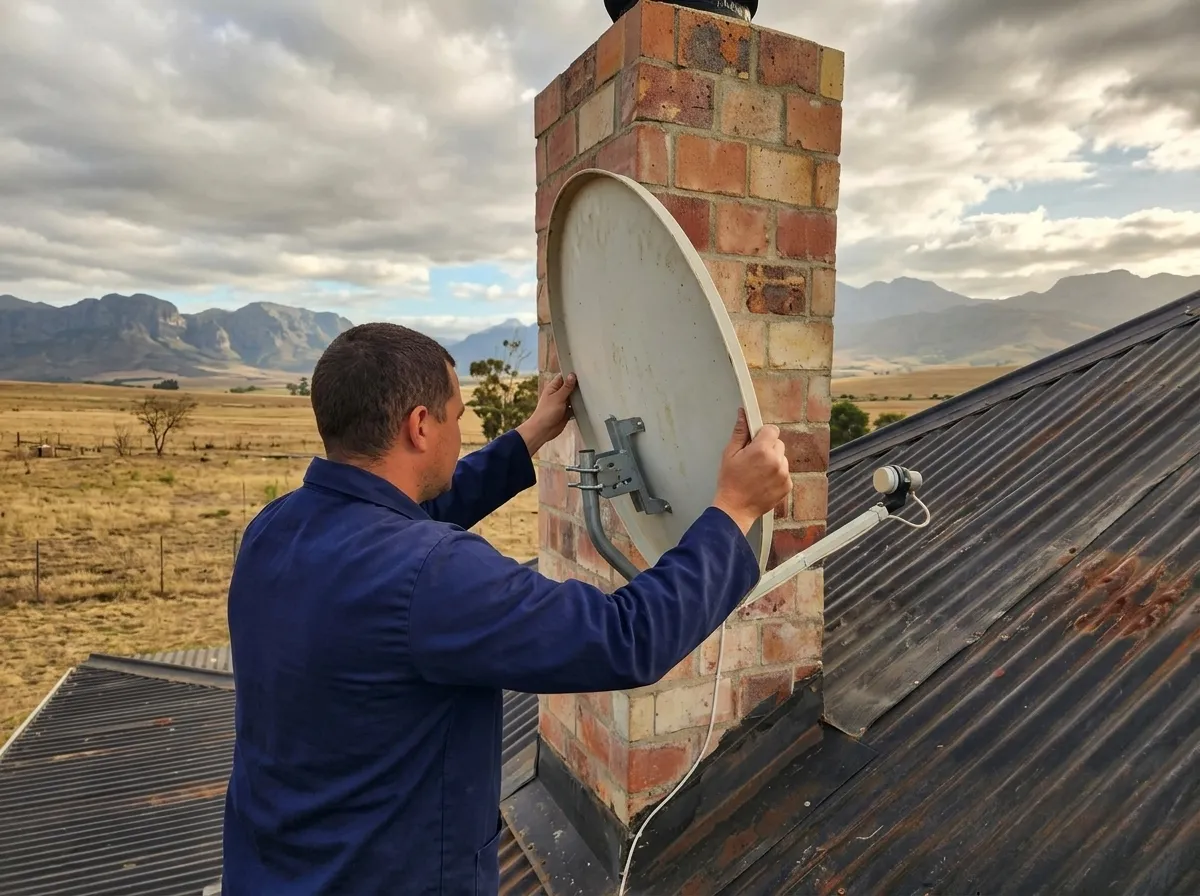
Satellite Dish Installation & Alignment
New, moved or knocked-out dishes, aligned with a signal meter and braced for Western Cape wind.
- 38 Google reviews from customers
- 3+ years Installing across the Western Cape
- Every tunerTested with a signal meter before we leave
- From R450 Call or WhatsApp for your price
How we work
- Aligned with a signal meter
- Galvanised or stainless brackets
- Braced against the southeaster
- 60, 80 and 90cm dishes
A DSTV dish only works when it points at one satellite, and a few millimetres of movement at the dish can lose it. Get it wrong and you get pixelation, E48-32, or a picture that disappears on windy days. We fit, move and realign 60, 80 and 90cm dishes on roofs, walls and poles, and we line up every one with a signal meter rather than by eye.
This page covers the dish itself. For the full job, including the decoder and extra TV points, see DSTV installation. If a dish that used to work has stopped giving a signal, DSTV repairs is the quicker route.
What we do with dishes
Pick the job closest to yours, or call and we will work it out together.
-
New dish: 60, 80 or 90cm
We supply and fit the dish with a galvanised bracket, Smart LNB and UV-stable RG6 cable. 80cm is our usual choice, and it is what DStv recommends with an Explora Ultra. A 90cm dish suits coastal and fringe areas where rain fade is a problem. A 60cm dish is only enough where the signal is strong.
-
Smart LNB and quad LNB upgrades
A Smart LNB is what current decoders need, and it is the usual upgrade for Extraview. Where an older multi-room system still relies on a quad LNB, we test it, and replace it if it is failing.
-
Realignment with a signal meter
For a dish that has moved in the wind or been knocked by a ladder, a tree or a roofer. We peak it with the meter and lock it down.
-
Dish relocation
Moving the dish to a clearer spot on the same property, for example because a tree has grown or an extension went up.
-
Roof, wall and pole mounts
Corrugated roof, tiled roof, brick wall, chimney or a free-standing pole. We choose the mount for the surface and for the wind, not for how quick it is to fit.
-
Wind-proof bracing
Extra support for a dish that wanders in the southeaster, whether we fitted it or someone else did.
-
Dish removal
We remove old dishes before painting or re-roofing, take the brackets off and seal the holes.
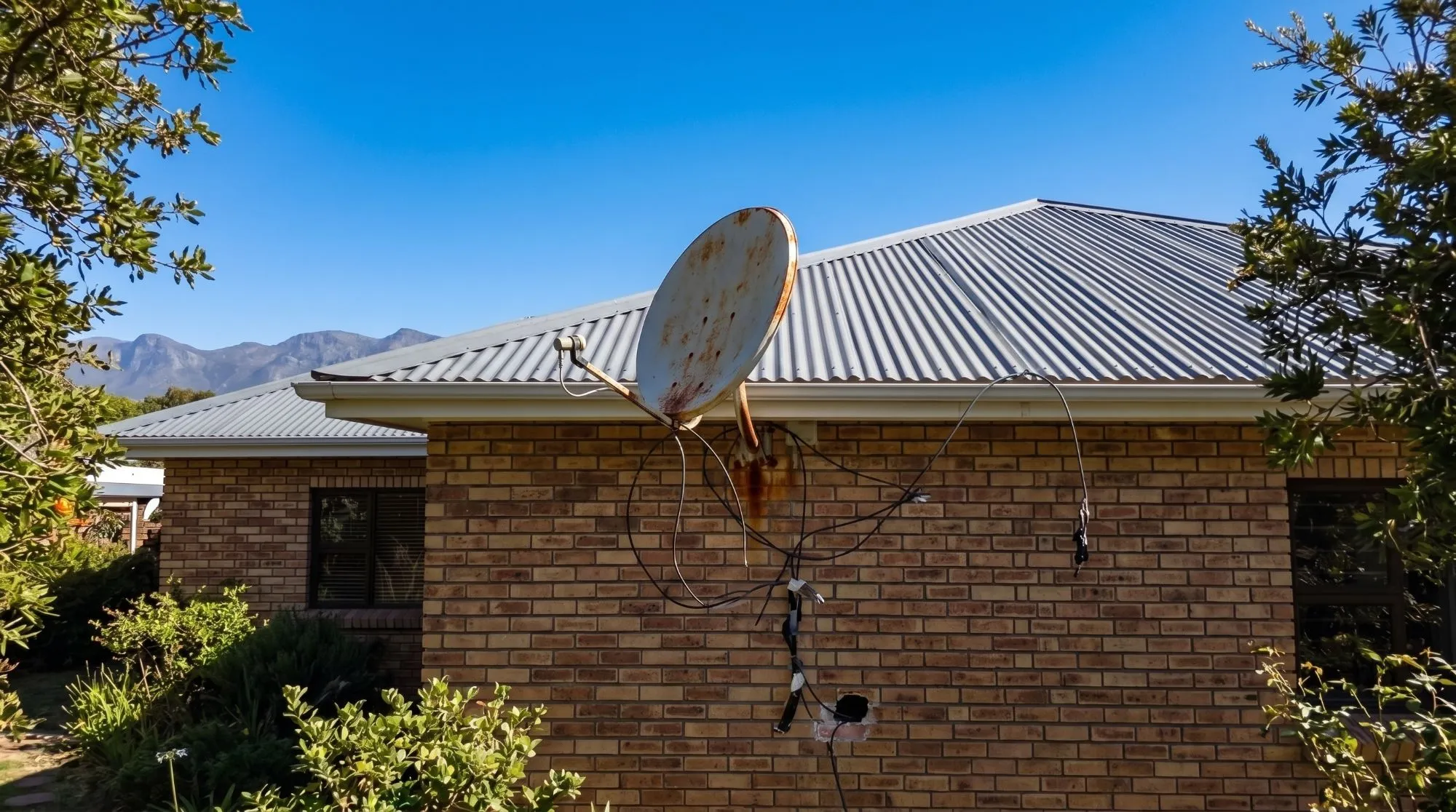
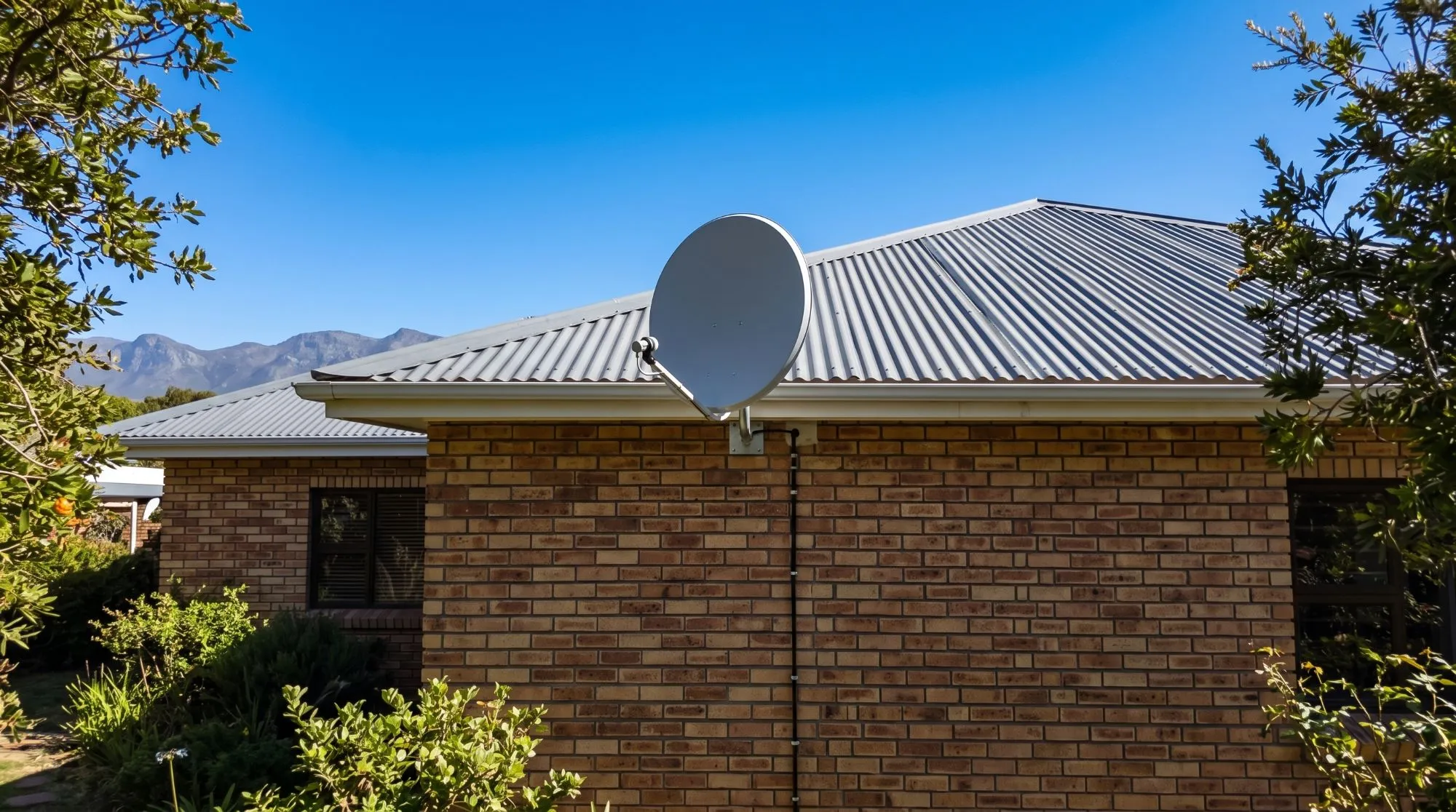
From rusted and dangling to neat and sealed
This is what most of our DSTV repair calls look like when we arrive, and what we leave behind. Scroll to see the difference.
- 1Old rusted dish and bracket taken down
- 2New dish on a galvanised wall bracket
- 3Aligned with a signal meter
- 4One clean cable, clipped and sealed
Keep scrolling, or drag the handle to compare.
Aligned with a meter, not by eye
E48-32 on screen, or a picture that breaks up in wind and rain.
Aligned on the meter and tested on every tuner.
A signal meter reads the satellite signal at the dish, before it reaches any decoder. We start from the rough position and move the dish a fraction at a time in direction, elevation and LNB skew until the reading peaks. A dish sitting on a weak reading can climb to a strong, locked signal once it is properly peaked. Then we lock the bracket and read the meter again, because tightening bolts can nudge a dish off the peak.
Which way does the dish point
DSTV is broadcast from the Intelsat IS-20 satellite at 68.5 degrees east. It is a geostationary satellite, so it hangs in one fixed spot in the sky. That is why a DSTV dish never needs to follow anything: once it is aimed, it stays aimed until something moves it.
From the Western Cape the satellite is to the north-east and fairly high in the sky. The dish tilts up noticeably instead of looking out towards the horizon. In practice the dish needs a clear view to the north-east, with no wall, tree or neighbouring roof in the way. A tree that is clear in winter can block the signal in summer, so we check the line of sight first.
Wind bracing
The southeaster is the main reason dishes fail here. A dish acts like a sail, and a thin bracket or a short wall mount flexes with every gust. Over a summer the dish creeps off the satellite.
We brace dishes against it. That means a heavy-gauge galvanised or stainless mount, through-bolted or fixed into masonry, a second support arm or stay where the wall allows, and bolts locked after alignment. Salt air corrodes standard steel brackets, so on the coast we use galvanised or stainless hardware and weatherproof connectors. If you already have a dish that wanders in the wind, bracing it is quicker and cheaper than replacing it.
Complexes and body corporate rules
If you live in a complex or estate, check the rules before we drill. Many body corporates and homeowners' associations have conduct rules on where dishes may go, how large they can be and whether the roof is common property. Approval comes from the trustees, not from us.
We can make that easier. We give you the proposed position, dish size and bracket type in writing so you can send it to your managing agent. If the complex would rather have one shared system than a dish on every unit, see communal DSTV installation.
What customers say
-
The service person arrived 100% on time for our appointment and the DSTV problem was fixed within minutes. Thanks for your great service.
Nico KoekemoerGoogle review, a year ago -
Every moment of dealing with this team, from the 1st phone call to them leaving my premises after a clean, successful and problem-free installation was professional, friendly and a winner. I had the incorrect problem diagnosis but they arrived with all the tools and replacements for and instance.
June SterlingGoogle review, 3 months ago -
Thank you for the excellent service received from Digitech today in fixing my DSTV signal. Your technician, Warren, was friendly and efficient and of great help. I will strongly recommend Digitech to anyone in need of DSTV installation.
Estelle MeyGoogle review, a year ago
What it costs
No surprises: you get the price before we book, and before any work starts.
The price depends on whether it is a new dish or a realignment, the dish size, the roof height, the cable run and how easy the access is. Call or WhatsApp 081 232 2249 for a price. A photo of where the dish goes helps.
Send a photo of the dish, the fault or the wall on WhatsApp and we’ll come back with a price, usually within working hours.
Satellite dish installation questions
Straight answers to what people ask us most. Anything else, WhatsApp a photo and ask.
Which way does the dish point?
A DSTV dish points at the Intelsat IS-20 satellite at 68.5 degrees east. From the Western Cape that is roughly north-east and fairly high in the sky. The dish needs a clear view in that direction, with no tree or wall in the way. Fine alignment is done with a signal meter, because a few millimetres of movement at the dish makes a big difference.
Do I need body corporate approval?
In most complexes and estates, yes. Conduct rules often control where a dish can go and how big it can be, and the roof is usually common property. Ask your trustees or managing agent first. We can give you the position, dish size and bracket details in writing to support your request.
How do I stop my dish moving in the wind?
Brace it. A strong galvanised or stainless bracket, fixed into masonry or a solid roof member, with a support arm or stay where possible, stops most wind movement. Bolts must be locked after alignment. If your dish already wanders in the southeaster, wind bracing on the existing dish is usually cheaper than a new one.
Which dish size do I need?
We usually fit 80cm, which DStv recommends with an Explora Ultra. A 60cm dish is only suitable where the signal is strong, and a 90cm dish is the better choice on the coast and in fringe areas, where rain fade and wind are bigger problems. We confirm the size with a meter reading on the day.
Can you move my dish to another side of the house?
Yes, as long as the new spot has a clear view to the north-east. We remove the dish, refit it on a suitable bracket, run new cable if needed and realign it with a meter. If you are moving house instead, our DSTV installation page covers relocation to a new home.
Why did my dish lose signal when nothing has changed?
Something usually has: a gust has shifted the dish slightly, a tree has grown into the line of sight, or a bracket or connector has corroded. Look at the dish from the ground for an obstruction and check the cable. If you cannot see a cause, we meter-test it and realign it. See DSTV repairs.
More from Digitech
Satellite dish installation near you
Related services
More DSTV services
Need Satellite dish installation? Call or WhatsApp.
Call or WhatsApp with your area and the problem, or send a photo of the dish. You get a clear price before we start, and a technician who arrives with the parts.
Mon to Sat, 07:00 to 17:00. Emergency callouts 24/7